
How Can Engineers Contact Our Printed Electronics Lab?
Reach our printed electronics lab for research questions, prospective researcher inquiries, collaboration planning, and controlled lab visit requests.
Direct Inquiry Channels
The simplest route is direct email to the lab director. For most technical questions, collaboration discussions, and research introductions, contact Dr. Priya Narayanan. A short, specific note helps us route the question without turning the first exchange into a guessing exercise.
In practice, the most useful messages describe the material system, print method, substrate, and measurement question. If you are working on silver nanoparticle inks on flexible polymer films, say that. If your issue sits closer to curing behavior, nozzle reliability, line edge quality, adhesion, or sheet resistance drift, name the point of uncertainty.
Research Questions
Send questions about conductive inkjet printing, printed traces, process windows, materials compatibility, and characterization methods.
Collaboration Requests
Use email for early discussion of joint research, sponsored work, prototype evaluation, or shared experimental planning.
Academic Inquiries
Prospective PhD students and researchers should include a concise research interest and relevant technical background.
Opportunities for Prospective Researchers
Printed electronics research rewards people who can move between materials, machines, and measurements without treating them as separate worlds. A line that looks clean under a microscope may still fail electrically after bending. A conductive ink that prints well on one substrate may dewet on another. These are the kinds of problems our lab spends time with.
For prospective PhD students and researchers, the strongest introductions usually connect prior work to a specific question. We do not need a long autobiography. We do need enough context to understand how you think in the lab.
What to Include
- Your current program, position, or recent research role
- The printed electronics topic you want to study
- Relevant experience with ink formulation, printing, curing, microscopy, electrical testing, or device fabrication
- One question you would like to investigate in depth
How We Read It
We look for fit between the research question and the tools, methods, and active work in the lab. A focused note about aerosolized droplets, conductive trace morphology, or process repeatability often tells us more than a broad statement about interest in nanotechnology.
The gap we often see is not lack of enthusiasm. It is lack of technical framing. If you want to work on wearable circuits, for example, name the part that draws you in: stretchable interconnects, skin-safe substrates, encapsulation, fatigue testing, or signal stability. That makes the next conversation practical.
Partnership and Collaboration Guidelines
Our working assumption is simple: a useful collaboration starts with a well-shaped technical question. The question does not need to be fully solved. It should be narrow enough that we can identify materials, equipment, measurement methods, and decision points.
When a group contacts us about partnership, we usually begin by separating the problem into three parts: what must be printed, what must survive, and how success will be measured. For a conductive trace on a flexible substrate, that may mean line width, sheet resistance, bending radius, curing temperature, and adhesion after handling. Those details matter before anyone talks about scale.
Early-Stage Research
Best suited for questions about feasibility, material behavior, printability, or measurement strategy.
Prototype Support
Useful when a concept needs controlled printing, inspection, and iteration before committing to a larger build.
Longer Research Programs
Appropriate for multi-stage work involving materials selection, process development, testing, and documentation.
The main limitation at the contact stage is that we cannot evaluate every process detail from a short message. Still, a specific inquiry lets us decide whether the next step should be a technical exchange, a scoped research discussion, or a referral to a better resource.
For broader background on our focus areas, visit Research. For lab context and institutional orientation, see About.
Lab Visitation Procedures
Lab visits require advance coordination. We handle conductive inks, substrates, solvents, curing equipment, inspection tools, and prototype devices, so a visit needs a clear purpose before it goes on the calendar.
Start by emailing Dr. Priya Narayanan with the reason for the visit, the names and roles of visitors, and the technical areas you hope to discuss. If the visit relates to confidential work, mention that early so the right boundaries can be set before any technical exchange.
Before a Visit
- State the purpose of the visit in plain technical terms
- Identify whether you want a discussion, demonstration, or project planning session
- Share any safety, confidentiality, or access needs in advance
- Do not arrive without confirmation from the lab
During a Visit
Visitors should expect practical boundaries around active experiments, unpublished work, and equipment access. We prefer a focused visit where the right people are present over a broad tour that interrupts lab work.
This is less about formality than safety and usefulness. A planned visit lets us prepare relevant samples, decide which tools can be shown, and keep active print runs from being disturbed.
Our Research Team
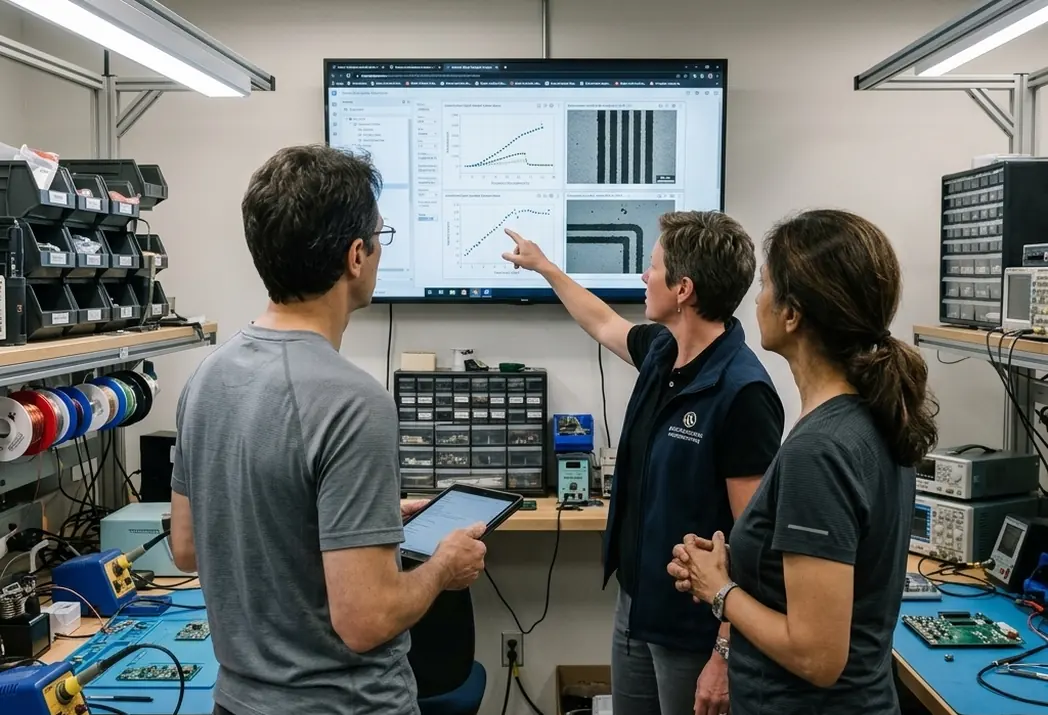
Our team works across ink behavior, print process control, substrate interaction, curing, inspection, and electrical characterization. The work is technical, but the first conversation does not need to be polished. A clear problem statement is enough to begin.
Dr. Priya Narayanan directs incoming inquiries and helps determine whether a question belongs in a research discussion, a prospective researcher conversation, a collaboration review, or a lab visit request. That routing matters. It keeps technical exchanges grounded and avoids asking the same background questions several times.
Primary Contact
Dr. Priya Narayanan
Director, Conductive Inkjet Printed Electronics Lab
Email: [email protected]
If you are unsure whether your question fits, send the concise version anyway. We would rather receive a focused technical note early than a polished proposal after the critical assumptions have already hardened.