Manufacturing
Liquid Wiring process for curved printed circuits

ESC closes search
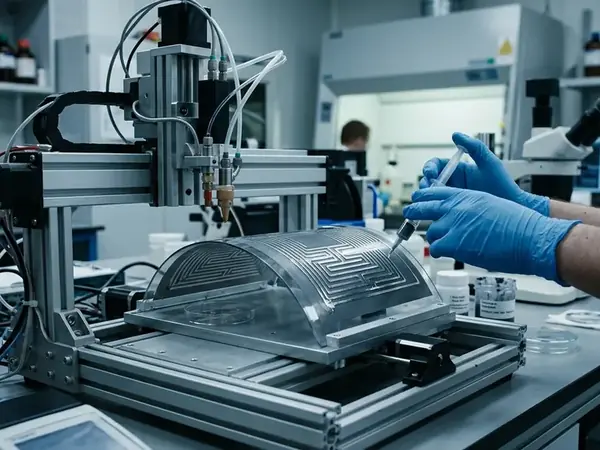
Liquid wiring manufacturing sits between materials chemistry and circuit fabrication: the trace is not installed as a finished conductor, it is formed from a printable conductive ink, placed, and then cured into an electrical path. Its distinctive strength is curved geometry production, where inkjet deposition can pattern non-planar housings, flexible films, and molded parts without the extra interconnects that flat boards often require. That makes the technique useful for engineers working on compact sensors, wearable circuits, and conformal antennas, provided they treat viscosity, adhesion, sintering, and printhead reliability as manufacturing variables rather than afterthoughts.
The practical question is less whether liquid wiring can replace copper in every setting, and more whether the intended device benefits from direct, additive conductor formation. On a rigid, high-current assembly, conventional PCB processes may still be the better fit; on a curved polymer carrier or a flexing medical patch, printed conductive ink can remove joints, fixtures, and hand placement steps.
Good process selection starts with the ink and ends with the substrate after curing, not at the print command. Engineers who account for particle loading, nozzle maintenance, wetting behavior, and thermal or photonic cure limits are in a stronger position to turn liquid wiring from a clever deposition method into a repeatable production route. The technique rewards early test coupons, especially when the final part bends or carries molded texture.