Defining the Preco Partnership
Early attempts to scale printed electronics often hit a hard physical limit. Flatbed systems worked perfectly for benchtop prototyping, but they severely bottlenecked throughput when we tried to move toward industrial production. The partnership between CIT and Preco Industries emerged specifically to dismantle that bottleneck.
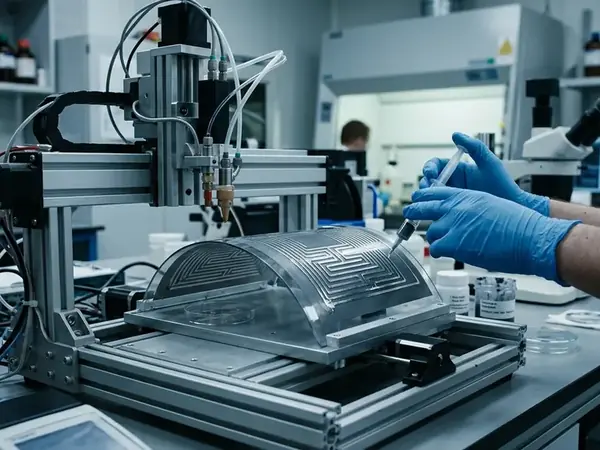
Our integration strategy prioritized narrow web reel-to-reel processing over flatbed systems to align with the continuous throughput demands of digital printing systems. We needed a mechanical platform capable of handling delicate flexible substrates at speed. This collaboration centered on integrating the core deposition chemistry with the MetalJet 6000 digital printing system. Preco brought the heavy web-handling expertise required to make continuous printing a reality.
The goal was never just to print conductive traces. We aimed to build a continuous manufacturing environment that could rival traditional etching in volume, if not entirely replace it for specific applications.
Core Technical Elements
Moving from a static flatbed to a moving web introduces immediate fluid dynamics challenges. We initially hypothesized that standard thermal curing would suffice for the catalytic ink once it hit the substrate.
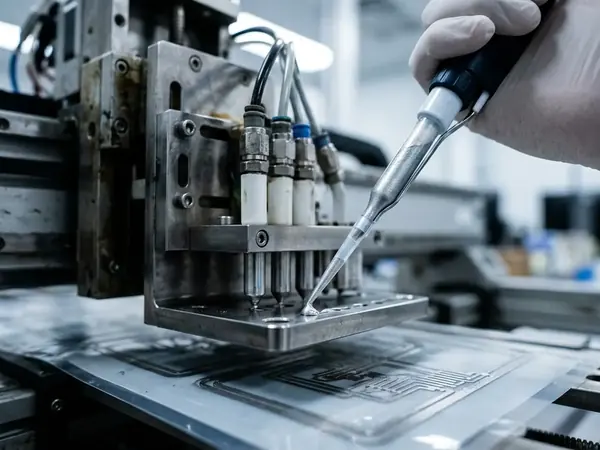
In controlled trials, engineers evaluated this thermal approach but quickly rejected it. The ambient heat caused excessive dot spread on non-porous substrates, destroying the fine resolution required for functional circuits. We implemented UV pinning immediately after droplet deposition. Freezing the ink in place with ultraviolet light preserved the precise geometry of the printed traces before they could spread.
Quick Tip: When transitioning from flatbed to reel-to-reel, always evaluate your ink's rheology under dynamic tension. Static drop tests rarely predict how an ink will behave on a moving web.
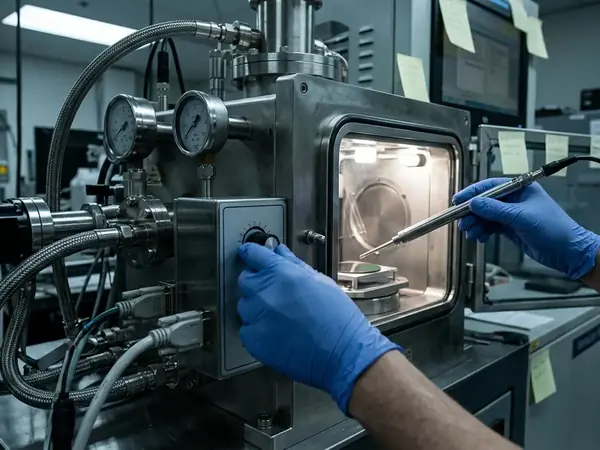
The actual metallization relied on electroless metal deposition as the primary plating process. Recorded results show electroless plating bath temperatures maintained between roughly 45°C and 55°C to ensure consistent copper growth over the printed catalyst. Substrate handling through these wet chemistry stages required a specialized web accumulator to manage tension and speed.
Preco also integrated a UV laser microvia capability into the line. This allowed us to drill precise vias with diameters at about 25 to 35 microns, enabling complex double-sided flexible circuit designs without removing the roll from the machine.
Development Partners and Responsibilities
Scaling a pilot line requires rigid boundaries between engineering disciplines. If everyone tries to solve every problem, the integration fails. Responsibilities were strictly delineated during the design phase.
Preco Industries operated as the machinery manufacturer and primary integrator. They engineered the web accumulator and tension controls, ensuring the physical substrate moved flawlessly through the printing and plating zones. CIT acted as the technology developer. Under the guidance of Mike Johnson as Director, the CIT team isolated their focus entirely on the core deposition chemistry and the electroless plating mechanics.
Xennia Technology joined the consortium as a specialized development partner. They tackled the complex fluid dynamics required to jet the catalytic ink reliably through industrial printheads. Managing the handoff between Preco's mechanical tension systems and Xennia's delicate fluid chemistry drove our daily engineering meetings at the facility near Cambridge CB4 2QH.
Key Dates and Milestones
The transition from prototype to production in 2005 exposed several mechanical realities we hadn't fully anticipated in the lab. We had to redesign the web accumulator capacity to ensure the digital printheads could continue firing seamlessly during physical roll changeovers. Stopping the printheads to splice a new roll caused the nozzles to dry out, so the accumulator had to store enough web material to keep the line moving while operators performed the splice.
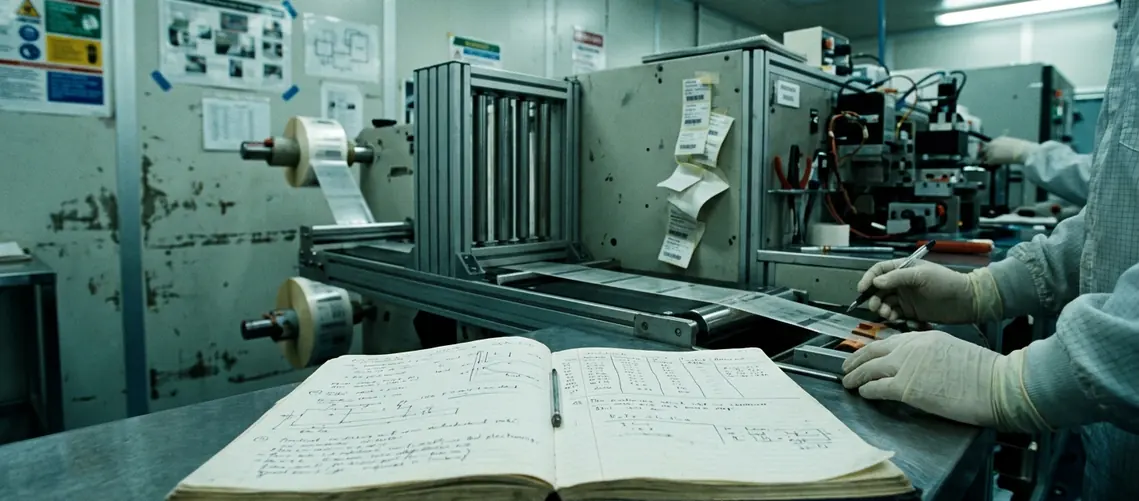
This mechanical shift occurred during a tight 14 to 18 month development cycle from benchtop proof-of-concept to the initial exhibition demonstration.
- May 2005: The technology received the Plastics Industry Award presentation, validating the core concept.
- Late 2005: We finalized the transition to production, locking in the web handling parameters.
- November 2005: The integrated system debuted at the Productronica exhibition.
- January 2006: A detailed CircuiTree article published the technical specifications of the rapid scale-up.
Primary Applications
Traditional flexible circuitry production relied heavily on copper-clad PET film etching. This subtractive method generated significant material waste—a costly inefficiency when scaling up to millions of units.
We contrasted this directly by focusing on additive manufacturing, with UHF antennas serving as our primary application. When targeting UHF antennas, the engineering team calibrated the electroless deposition time to achieve the exact skin depth required for radio frequency performance, avoiding the material waste inherent in subtractive etching.
The process was not without its hurdles. Early runs suffered from catalyst ink pooling on untreated PET films causing short circuits in fine-pitch antenna designs. We had to tightly control the surface energy of the incoming rolls to prevent the ink from migrating across the narrow gaps between antenna traces.
Note: Additive deposition only saves money if your yield remains high. Calibrating the plating time to match the required RF skin depth is critical; over-plating wastes copper and increases the weight of the final flexible circuit.
Industry Recognition and Scope
The direct printing of metals gained early traction as a core technology, culminating in a Plastics and Rubber Weekly award in 2005. However, we made deliberate choices about where this technology would compete.
The system architecture was deliberately constrained to high-volume roll-to-roll environments, bypassing low-volume prototyping markets to focus entirely on the economics of scale required for RFID tags. We knew the machine excelled at continuous runs, but it struggled with frequent material changeovers. According to measurements from the pilot line, we saw web tension requirements shifting drastically when transitioning from 50-micron to 125-micron flexible substrates. Recalibrating the accumulator for different thicknesses took time we couldn't afford in a high-mix, low-volume environment.
While this setup proved highly effective for specific PET films, it is not a universal solution for all flexible substrates. There is one catch to this optimal production environment: the electroless deposition integration requires substrates with a surface energy strictly between roughly 38 and 42 dynes/cm to ensure adequate catalyst adhesion without secondary plasma pre-treatment.
Summary: The Preco partnership succeeded because it married precise fluid chemistry with solid mechanical web handling. By constraining the scope to high-volume UHF antennas and strictly controlling substrate parameters, the team transformed a benchtop concept into a viable industrial process.